
MEPCO Tariff Rates 2026: What You Actually Pay Per Unit
MEPCO doesn’t charge one flat rate for electricity. What you pay per unit depends on your consumer category (residential, commercial, industrial, or agricultural), how many units you use in a month, and whether you fall under NEPRA’s “protected” or “non-protected” classification. This page breaks down the current rates for each category, based on NEPRA’s tariff notification S.R.O. 279(I)/2026, and explains what actually determines which rate applies to you.
Protected vs. Non-Protected: Why It Matters
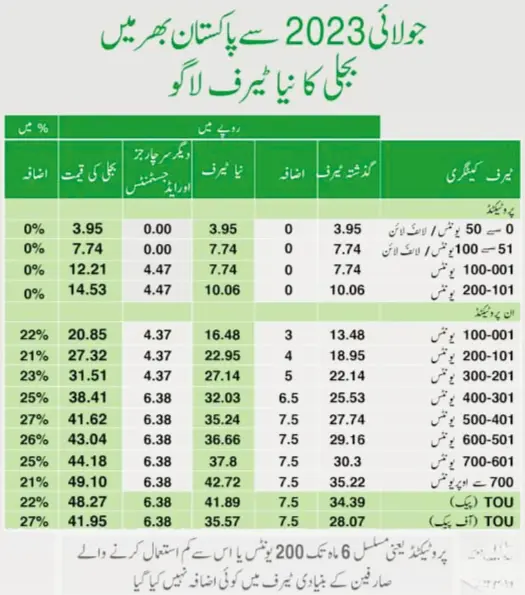
If your household’s average consumption over the past six billing cycles is 200 units a month or less, you’re classified as a protected consumer and billed at a lower rate. Cross that average even once, and MEPCO moves you to non-protected rates, which are considerably higher across every slab.
For example, a household that normally uses 150 units a month but runs extra air conditioning one summer month and hits 250 units may lose its protected status for the following six-month review period, even though the higher month was an exception rather than the norm. This is why consistently tracking your monthly usage matters more than most people realize.
A separate “lifeline” category exists for very low usage (up to 100 units) and carries the lowest rate of all for the lowest-income households.
MEPCO Tariff Rates
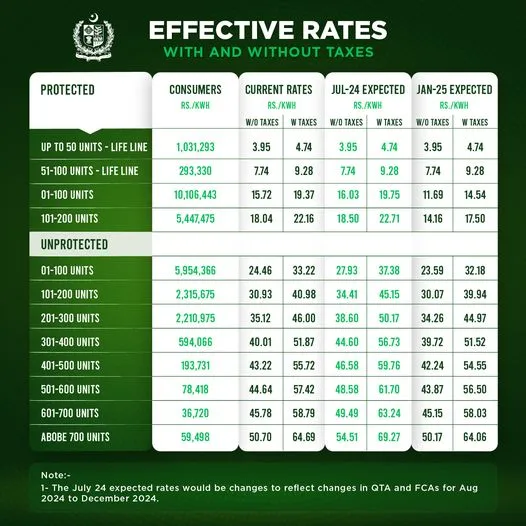
The detailed Mepco tariff rates of all Mepco consumers are listed below.
Domestic (Residential) Tariff — Category A-1
For sanctioned loads up to 5 kW:
| Monthly Usage | Consumer Type | Rate (Rs/unit) |
|---|---|---|
| Up to 50 units | Lifeline (protected) | 3.95 |
| 1–100 units | Lifeline (protected) | 7.74 |
| 1–100 units | Protected | 10.54 |
| 101–200 units | Protected | 13.01 |
| 1–100 units | Non-protected | 22.44 |
| 101–200 units | Non-protected | 28.91 |
| 201–300 units | Non-protected | 33.10 |
| 301–400 units | Non-protected | 36.46 |
| 401–500 units | Non-protected | 38.95 |
| 501–600 units | Non-protected | 40.22 |
| 601–700 units | Non-protected | 41.85 |
| Above 700 units | Non-protected | 47.20 |
Connections with a 5 kW or larger sanctioned load are billed on a Time-of-Use (TOU) meter instead, with separate peak and off-peak rates. As of the current notification, TOU domestic peak-hour usage is billed at Rs. 46.85/unit and off-peak at Rs. 34.53/unit.
Even if you use zero units in a month, MEPCO still applies a minimum monthly charge: Rs. 75 for single-phase connections and Rs. 150 for three-phase connections, covering the cost of maintaining your connection.
Commercial Tariff — Category A-2
Shops, offices, and other commercial connections are billed at a flat rate rather than a rising slab structure, which is why business owners often see a higher, more consistent per-unit cost than households do.
| Category | Fixed Charges | Rate (Rs/unit) |
|---|---|---|
| Load up to 5 kW | Rs. 1,000/month | 37.44 |
| Load 5 kW & above | Rs. 1,250/kW/month | 39.76 |
| Time of Use — Peak | Rs. 1,250/kW/month | 43.82 |
| Time of Use — Off-Peak | Rs. 1,250/kW/month | 35.15 |
A shop owner running a store with a 5 kW connection, for instance, would fall under the second row above rather than the residential slabs — this is a common point of confusion for small business owners who assume commercial billing works the same way as their home bill.
Industrial Tariff — Category B
Factories and industrial units are billed according to their sanctioned load and voltage level, since larger operations draw power at higher voltages through dedicated infrastructure.
| Category | Fixed Charges | Rate (Rs/unit) |
|---|---|---|
| B1 — up to 25 kW | Rs. 1,000/month | 26.23 |
| B2(a) — 25–500 kW | Rs. 1,250/kW/month | 26.16 |
| B3 — up to 5,000 kW (11/33 kV) | Rs. 1,250/kW/month | Peak 35.68 / Off-Peak 23.67 |
| B4 — 66/132 kV & above | Rs. 1,250/kW/month | Peak 35.68 / Off-Peak 23.38 |
C-Single Point Supply
| Tariff Category | Fixed Charges | Variable Charges with PYA |
|---|---|---|
| C(1) a | – | 25.25 |
| C(1) b | 500 | 25.05 |
| C(2) a | 460 | 24.95 |
| C(3) a | 440 | 24.84 |
| C(1) c | 500 | Peak-28.64 Off-Peak-22.04 |
| C(2) b | 460 | Peak-28.64 Off-Peak-23.44 |
| C(3) b | 440 | Peak-28.64 Off-Peak-23.24 |
For single-point supply consumers, fixed charges will be billed based on 50% of the sanctioned load or the actual MDI for the month, whichever is higher.
Agricultural Tariff — Category D
Tube wells and other agricultural connections are billed separately, generally at lower rates than commercial or industrial categories, to support farming costs.
| Category | Fixed Charges | Rate (Rs/unit) |
|---|---|---|
| D-1(a) — SCARP, under 5 kW | – | 39.87 |
| D-2(a) — Tube wells | Rs. 400/kW/month | 28.90 |
| D-1(b) — SCARP, 5 kW & above | Rs. 400/kW/month | Peak 42.79 / Off-Peak 34.71 |
| D-2(b) — Agricultural, 5 kW & above | Rs. 400/kW/month | Peak 29.54 / Off-Peak 28.69 |
Even with zero consumption, agricultural connections carry a minimum monthly charge of Rs. 2,000.
E-Temporary Supply Tariff
| Tariff Category | Fixed Charges | Variable Charges with PYA |
|---|---|---|
| E1 (i) | – | 29.64 |
| E1 (ii) | – | 25.62 |
| E2 | 200 | 27.5 |
In this tariff category of E (i)(ii), the minimum bill of the consumer is Rs. 50/- per day, even with no energy usage.
F-Seasonal Industrial Supply Tariff
125 % of the following relevant industrial tariff
G-Public Lightning
| Tariff Category | Fixed Charges | Variable Charges with PYA |
|---|---|---|
| Street Lightning | – | 28.94 |
According to tariff G, the minimum monthly charge will be Rs 500/— per kW of lamp capacity installed.
H-Residential Colonies attached to Industrial Premises
| Tariff Category | Fixed Charges | Variable Charges with PYA |
|---|---|---|
| Railway Traction | – | 29.24 |
What’s Not Included in This Table
The rates above only cover the base energy charge. Your actual bill also includes:
- Fuel Price Adjustment (FPA) — added or subtracted monthly based on actual fuel costs versus what was estimated.
- General Sales Tax (GST) at 17–18%.
- Electricity Duty, typically 1–1.5% depending on category.
- Income tax withholding, which varies by bill amount and tariff category.
This is why your per-unit cost on the printed bill is usually higher than the base rate shown in the table above; it’s the base rate plus these additional government-mandated charges.
How Often Do These Rates Change?
NEPRA reviews and adjusts DISCO tariffs periodically, sometimes annually as part of a multi-year determination, and separately through quarterly fuel cost adjustments that don’t change the base table but do change your final bill. We check this page against NEPRA’s published notifications and update it whenever a new determination is notified. If you’re comparing this to a very recent bill and see a difference, it likely reflects a quarterly FPA adjustment rather than an error in the base rate.
The Mepco tariff rate is up to date as per the latest NEPRA Tariff. If you find any mistakes, feel free to contact us.