
MEPCO Tariff Rates 2026: What You Actually Pay Per Unit
MEPCO doesn’t charge one flat rate for electricity. What you pay per unit depends on your consumer category (residential, commercial, industrial, or agricultural), how many units you use in a month, and whether you fall under NEPRA’s “protected” or “non-protected” classification.
This page breaks down the current rates for each category, based on NEPRA’s tariff notification S.R.O. 279(I)/2026, and explains what actually determines which rate applies to you. To estimate your own bill, use our MEPCO bill calculator.
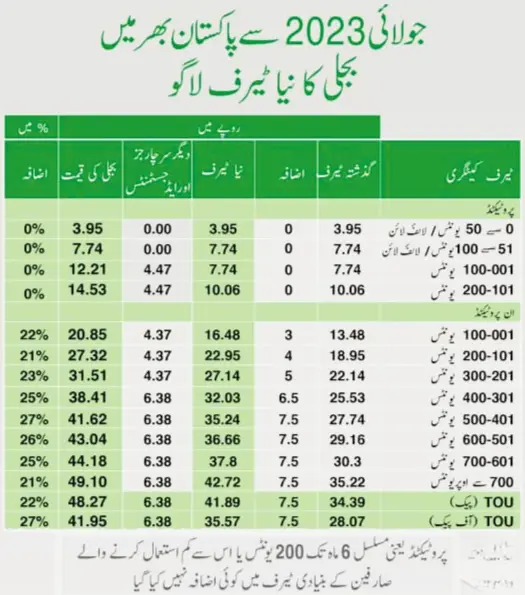
Protected vs. Non-Protected: Why It Matters
A household is billed at protected rates when it uses 200 units or less in every billing month of the past six months. Going above 200 units in a month can move the connection to non-protected rates, which are much higher in every slab. You return to protected rates after six consecutive months at 200 units or less. Our guide to protected and non-protected tariffs explains the rule in detail.
For example, a household that normally uses 150 units a month but runs extra air conditioning one summer month and hits 250 units can lose its protected status and be billed at non-protected rates until it completes six consecutive months at 200 units or less, even though the higher month was an exception rather than the norm. That is why tracking your monthly usage consistently matters more than most people realize.
Lifeline rates apply to very low usage: Rs 3.95 per unit up to 50 units and Rs 7.74 per unit up to 100 units
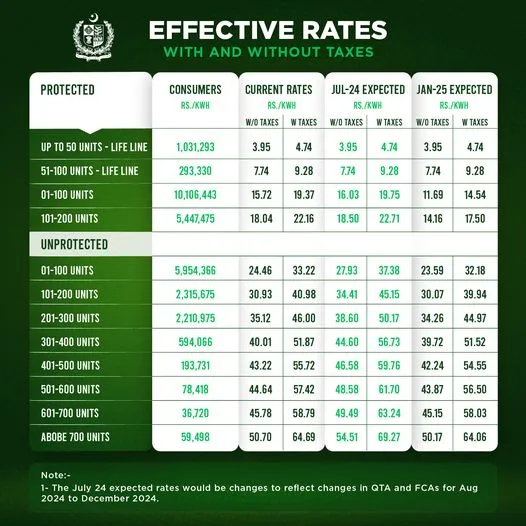
MEPCO Tariff Rates
Rates for each consumer category are listed below.
Domestic (Residential) Tariff — Category A-1
For sanctioned loads up to 5 kW:
| Monthly Usage | Consumer Type | Fixed charge (Rs/kW/month) | Rate (Rs/unit) |
|---|---|---|---|
| Up to 50 units | Lifeline (protected) | – | 3.95 |
| Up to 100 units | Lifeline (protected) | – | 7.74 |
| 1–100 units | Protected | 200 | 10.54 |
| 101–200 units | Protected | 300 | 13.01 |
| 1–100 units | Non-protected | 275 | 22.44 |
| 101–200 units | Non-protected | 300 | 28.91 |
| 201–300 units | Non-protected | 350 | 33.10 |
| 301–400 units | Non-protected | 400 | 36.46 |
| 401–500 units | Non-protected | 500 | 38.95 |
| 501–600 units | Non-protected | 675 | 40.22 |
| 601–700 units | Non-protected | 675 | 41.85 |
| Above 700 units | Non-protected | 675 | 47.20 |
If you use more than 200 units in a month, read how the protected and non-protected rule works.
Lifeline consumers do not pay the per-kW fixed charge. Instead, they pay the minimum monthly charge: Rs 75 for single-phase and Rs 150 for three-phase connections.
Connections with a sanctioned load of 5 kW or more are billed on a Time-of-Use (TOU) meter: Rs 46.85 per unit at peak, Rs 34.53 off-peak, and a fixed charge of Rs 675 per kW. For TOU connections, the fixed charge is billed on 50% of the sanctioned load or the actual maximum demand (MDI), whichever is higher. Shifting heavy appliances out of peak hours can lower a TOU bill; see our peak hours guide.
Prepaid residential connections are billed at Rs 42.12 per unit and Rs 675 per kW. See Fixed Charges on Your MEPCO Bill below.
Commercial Tariff — Category A-2
Shops, offices, and other commercial connections are billed at a flat rate rather than a rising slab structure, so business owners often see a higher, more consistent per-unit cost than households.
| Category | Fixed Charges | Rate (Rs/unit) |
|---|---|---|
| Load up to 5 kW | Rs. 1,000/month | 37.44 |
| Load 5 kW & above | Rs. 1,250/kW/month | 39.76 |
| Time of Use — Peak | Rs. 1,250/kW/month | 43.82 |
| Time of Use — Off-Peak | Rs. 1,250/kW/month | 35.15 |
| Electric vehicle charging station | – | 23.57 |
| Prepaid commercial supply | Rs 1,250/kW/month | 42.38 |
Where the fixed charge is per kW, it is billed on 25% of the sanctioned load or the actual maximum demand (MDI) for the month, whichever is higher.
General Services Tariff — Category A-3
| Category | Fixed Charge | Rate (Rs/unit) |
|---|---|---|
| General services | Rs 1,000/month | 42.48 |
Industrial Tariff — Category B
Factories and industrial units are billed according to their sanctioned load and voltage level, since larger operations draw power at higher voltages through dedicated infrastructure.
| Category | Fixed Charges | Rate (Rs/unit) |
|---|---|---|
| B1 — up to 25 kW | Rs. 1,000/month | 26.23 |
| B2(a) — 25–500 kW | Rs. 1,250/kW/month | 26.16 |
| B3 — up to 5,000 kW (11/33 kV) | Rs. 1,250/kW/month | Peak 35.68 / Off-Peak 23.67 |
| B4 — 66/132 kV & above | Rs. 1,250/kW/month | Peak 35.68 / Off-Peak 23.38 |
| B1(b) TOU — up to 25 kW | Rs 1,000/month | Peak 35.74 / Off-Peak 25.48 |
| B2(b) TOU — 25–500 kW | Rs 1,250/kW/month | Peak 35.68 / Off-Peak 22.83 |
Where the fixed charge is per kW, it is billed on 25% of the sanctioned load or the actual maximum demand (MDI) for the month, whichever is higher.
C-Single Point Supply
| Tariff Category | Fixed Charges | Rate (Rs/unit) |
|---|---|---|
| C-1(a) — 400/230 V, load below 5 kW | Rs 2,000/month | 43.39 |
| C-1(b) — above 5 kW, up to 500 kW | Rs 1,250/kW/month | 40.63 |
| C-2(a) — 11/33 kV, up to 5,000 kW | Rs 1,250/kW/month | 40.57 |
| C-3(a) — 66 kV and above, above 5,000 kW | Rs 1,250/kW/month | 40.77 |
| C-1(c) TOU — 400/230 V, above 5 kW up to 500 kW | Rs 1,250/kW/month | Peak 46.31 / Off-Peak 37.54 |
| C-2(b) TOU — 11/33 kV, up to 5,000 kW | Rs 1,250/kW/month | Peak 46.31 / Off-Peak 36.03 |
| C-3(b) TOU — 66 kV and above | Rs 1,250/kW/month | Peak 46.31 / Off-Peak 35.76 |
Where the fixed charge is per kW, it is billed on 25% of the sanctioned load or the actual maximum demand (MDI) for the month, whichever is higher.
Agricultural Tariff — Category D
Tube wells and other agricultural connections are billed separately, generally at lower rates than commercial or industrial categories, to support farming costs.
| Category | Fixed Charges | Rate (Rs/unit) |
|---|---|---|
| D-1(a) — SCARP, under 5 kW | – | 39.87 |
| D-2(a) — Tube wells | Rs. 400/kW/month | 28.90 |
| D-1(b) — SCARP, 5 kW & above | Rs. 400/kW/month | Peak 42.79 / Off-Peak 34.71 |
| D-2(b) — Agricultural, 5 kW & above | Rs. 400/kW/month | Peak 29.54 / Off-Peak 28.69 |
Even with zero consumption, agricultural connections carry a minimum monthly charge of Rs. 2,000.
E-Temporary Supply Tariff
| Tariff Category | Fixed Charges | Rate (Rs/unit) |
|---|---|---|
| E-1(i) — Residential supply | Rs 675/kW/month | 52.89 |
| E-1(ii) — Commercial supply | Rs 5,000/month | 53.44 |
| E-2 — Industrial supply | Rs 5,000/month | 42.25 |
F-Seasonal Industrial Supply Tariff
Seasonal industrial connections pay 125% of the relevant industrial tariff. A seasonal consumer can switch to the regular tariff, and back, when taking a new connection or at the start of the season. Once chosen, the option stays in force for at least one year.
G -Public Lighting
| Tariff Category | Fixed Charges | Rate (Rs/unit) |
|---|---|---|
| G – Street lighting | Rs 2,000/month | 42.91 |
| H – Residential colonies attached to industrial premises | Rs 2,000/month | 42.10 |
According to tariff G, the minimum monthly charge will be Rs 500/— per kW of lamp capacity installed.
Fixed Charges on Your MEPCO Bill (2026)
MEPCO fixed-charges are a monthly amount added to your bill based on your sanctioned load in kilowatts (kW), not on how many units you use. Under NEPRA’s S.R.O. 279(I)/2026, domestic consumers other than lifeline users pay between Rs 200 and Rs 675 per kW each month, even in a month with very low or zero usage.
What are fixed charges on an electricity bill?
A fixed charge covers the cost of keeping your connection ready, such as the wires, transformer, and meter, whether or not you switch anything on. It is separate from the per-unit rate in the tables above, so it appears as its own line on your bill.
How much are MEPCO fixed charges per kW?
| Consumer Type | Fixed Charge (per kW of sanctioned load, per month) |
| Lifeline Consumers | No per-kW fixed charge. The minimum monthly charge applies instead: Rs 75 (single-phase) or Rs 150 (three-phase). |
| Protected consumers | Rs 200 per kW for 1–100 units and Rs 300 per kW for 101–200 units. |
| Non-Protected Consumers | Higher slabs, going up to Rs 675 per kW for the highest usage slab. |
The exact rate for your slab is printed on your bill. If it differs from this table, trust your bill and the latest NEPRA notification.
Fixed Charges on Your MEPCO Bill (2026)
| Consumer type | Fixed charge per kW of sanctioned load, per month |
| Lifeline consumers | None. The minimum monthly charge (Rs 75 single-phase, Rs 150 three-phase) applies instead. |
| Protected, 1–100 units | Rs 200 |
| Protected, 101–200 units | Rs 300 |
| Non-protected, 1–100 units | Rs 275 |
| Non-protected, 101–200 units | Rs 300 |
| Non-protected, 201–300 units | Rs 350 |
| Non-protected, 301–400 units | Rs 400 |
| Non-protected, 401–500 units | Rs 500 |
| Non-protected, above 500 units | Rs 675 |
| Time-of-Use (5 kW and above) | Rs 675, billed on 50% of sanctioned load or actual MDI, whichever is higher |
Your slab is the usage band your bill falls in, so the per-kW rate can change from month to month. Your bill shows the slab and rates.
How to calculate your fixed charges
Multiply your sanctioned load (in kW) by the per-kW rate for your slab. Two examples:
- A protected consumer with a 2 kW load in the 1–100 unit slab: 2 × Rs 200 = Rs 400 per month.
- A non-protected consumer with a 5 kW load in the highest slab: 5 × Rs 675 = Rs 3,375 per month.
Taxes such as GST are added to your total bill as usual. Your sanctioned load is shown in the consumer details part of your bill, so you can check it in a minute.
What changed from the earlier system?
Until early 2026, fixed charges depended on how much electricity you used. They applied only above 300 units a month and ranged from Rs 200 to Rs 1,000. The July 2024 proposal that many people still read about was that older consumption-based design. The current system is tied to sanctioned load and applies to every domestic consumer except lifeline users.
Do solar and net metering consumers pay fixed charges?
Yes. The charge depends on your sanctioned load, not on the units you take from the grid, so installing solar panels does not remove it. See our net metering guide for how exported units are credited.
By lowering your sanctioned load, and only if your real power needs are smaller than the load on record. A load reduction request is made to your MEPCO sub-division office. Check your actual appliance load first, because exceeding a reduced load can lead to penalties.
Commercial, industrial, and agricultural: Can you reduce your fixed charges?
Connections have their own fixed charges, shown in the category tables above.
Last reviewed: October 2026. This is an independent informational website and is not affiliated with MEPCO or any government organization. Verify important billing details through your bill or official MEPCO channels.
What’s Not Included in This Table
The rates above only cover the base energy charge. Your actual bill also includes:
- Fuel Price Adjustment (FPA): added or subtracted monthly based on actual fuel costs compared with the estimate.
- Fixed charges: a monthly amount based on your sanctioned load, explained in the fixed charges section above.
- General Sales Tax (GST): charged as a percentage of the bill. Your bill shows the rate and amount.
- Electricity duty: this is a provincial duty. In June 2025, the federal government announced it would stop collecting it through electricity bills from July 2025, so check whether it appears on your latest bill.
- Income tax withholding: varies by bill amount and tariff category.
This is why your per-unit cost on the printed bill is usually higher than the base rate shown in the table above; it’s the base rate plus these additional government-mandated charges.
How Often Do These Rates Change?
NEPRA reviews and adjusts DISCO tariffs from time to time. Fuel and quarterly adjustments change your final bill without changing the base tables on this page. The tables here follow NEPRA S.R.O. 279(I)/2026 (February 2026). If your bill differs from what you see here, a monthly fuel price adjustment is the most likely reason. If you spot a mistake, please contact us.
Last reviewed: October 2026. This is an independent informational website and is not affiliated with MEPCO or any government organization. Verify important billing details through your bill or official MEPCO channels.
The Mepco tariff rate is up to date as per the latest NEPRA Tariff. If you find any mistakes, contact us.