
Protected vs Non-Protected Tariff: How MEPCO Decides Your Rate
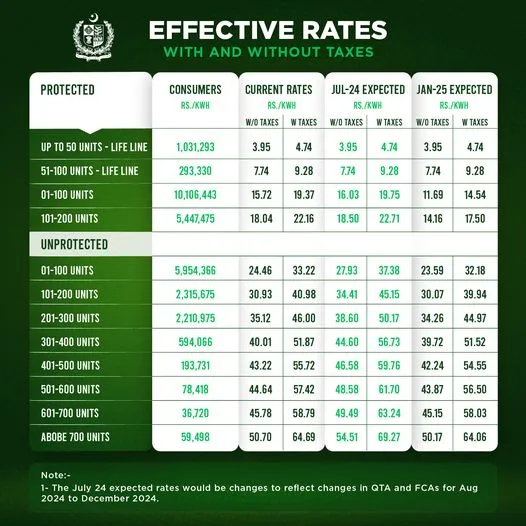
Protected and non-protected tariffs are two rate bands for residential electricity connections. A household that uses 200 units or less in every billing month of the past six months is billed at the lower protected rates. Crossing 200 units can move it to non-protected rates, which are more than double in the same slab.
This page explains who qualifies, how status is lost and regained, and how to stay under the limit. For the complete rate tables, see our MEPCO tariff rates page.
Protected vs Non-Protected at a Glance
| Monthly usage | Protected (Rs/unit) | Non-protected (Rs/unit) | How much higher |
|---|---|---|---|
| 1–100 units | 10.54 | 22.44 | About 2.1 times |
| 101–200 units | 13.01 | 28.91 | About 2.2 times |
| 201–300 units | Not available | 33.10 | Protected limit is 200 units |
These are base energy rates from NEPRA S.R.O. 279(I)/2026, as listed on our tariff page. They do not include fuel price adjustment, fixed charges, or taxes. Lifeline rates (Rs 3.95 up to 50 units and Rs 7.74 up to 100 units) sit inside the protected group.
Who Is a Protected Consumer?
- Protected rates are for residential (domestic) connections. Commercial, industrial, and agricultural connections do not get them.
- The usual test is 200 units or less in every billing month of the past six months. It is not an average, so one high month counts.
- Lifeline is the lowest part of the protected group, covering usage up to 50 units and up to 100 units.
- Connections of 5 kW and above on a Time-of-Use meter are billed on separate peak and off-peak rates instead.
Distribution companies apply this rule through their billing systems, and details vary by company. If your bill shows a category you did not expect, ask your MEPCO sub-division office.
How you lose protected status
Using more than 200 units in a billing month, even by one unit, can move you to non-protected rates. Summer is the usual cause. A single air conditioner running most of the day can use well over 200 units a month on its own, so a household that normally uses 150 units can cross the line in one hot month.
How you get it back
As commonly reported, you return to protected rates after six consecutive billing months at 200 units or less. During those months, you are billed at non-protected rates, so one hot month can affect your bills for half a year.
What Happens at 201 Units
The jump is sharper than most people expect. At 200 units, a protected household is in the 101–200 slab at Rs 13.01 per unit. At 201 units, a non-protected household is in the 201–300 slab at Rs 33.10 per unit. That is the same electricity at more than 2.5 times the rate, before fuel adjustment and taxes.
The slab line on your own bill shows how your units were priced. You can also estimate a bill with our MEPCO bill calculator.
How to Stay Under 200 Units
- Work from a daily budget. 200 units over a 30-day cycle is about 6.5 units a day.
- Read your meter on the same day each week and subtract your last bill’s reading. That shows how many units you’ve used so far in this cycle.
- Check usage in the last ten days of the cycle. If you are near 190, cut back the biggest loads first: air conditioner, water pump, geyser, and iron.
- Run heavy appliances outside peak hours where you can. Our peak hours guide lists the timings.
If your meter reading looks wrong, raise it with your sub-division office before the bill is issued.
What Protected Status Does Not Change
Protected status lowers your per-unit rate. It does not remove the other parts of the bill. Fuel price adjustment, taxes, and the load-based fixed charge still apply. The fixed charge is explained in the fixed charges section of our tariff page.
Last reviewed: October 2026. This is an independent informational website and is not affiliated with MEPCO or any government organization like NEPRA. Verify your category through your bill or official MEPCO channels.
FAQ’s